Article 1 of 5: Real Estate As An Investment Option
This is the first in a series of five pieces to help investors understand the benefits of owning commercial real estate, then differentiate the dynamics and variety of ownership channels.
For centuries, the two asset classes creating the most wealth have been stocks and real estate. Today, most people’s first investments are in stocks or stock funds. Established investors should consider adding real estate investments to enhance their portfolio.
Real estate has a different return composition.
Over the long term, U.S. stocks (i.e., the S&P 500 Index) have averaged annual returns in the 11% range. This comes mostly from appreciation and a modest (around 2%) dividend. Established real estate investments have comparable total returns, but a different return composition, with about 70% of the return coming from income. There are also tax advantages that can improve after-tax return. Both stocks and real estate investments can benefit from long-term capital gain tax rates, but real estate can offer additional tax benefits from pass-through depreciation.
Real estate has a lower risk profile than stocks.
Stock prices can fluctuate dramatically with quarterly earnings surprises, broad stock market gyrations and investor emotions. Real estate prices are driven by demand, net operating income (NOI), and interest rates, which all move more slowly. Demand can be driven by sector (apartments or warehouses, e.g.) or by the growth or decline of a specific market. Rising borrowing costs can restrict net income, however this is often offset by price appreciation in an inflationary environment.
Real estate behaves differently than stocks during economic cycles.
Stock prices are driven by earnings expectations and rise or fall in anticipation of changes in corporate earnings and broader economic forces. Building values tend to be much more stable through cycles, as values are determined by consistent rental income rather than less predictable corporate profit expectations.
Geography and sector diversity are important considerations.
The types of buildings you invest in and their location are important. Population shifts, regional economies, state-specific tax and business climates all impact real estate.
To learn more about how real estate can be classified by sector, location, and risk/return characteristics, read the next blog in our real estate series, “All Real Estate Investments are Different”.
As machines become more intelligent, their role as “Robo-Advisors” is destined to become more widespread. It’s popular for being a cheaper way for big firms to invest your money, but it is based on only a limited set of facts, like your age, financial stability, and your appetite for risk. Sadly, no matter how good it may seem, computers will only follow instructions.
Your financial planning should be more personal and nimble than a computer program. Automatically rebalancing a portfolio is fine, but you deserve professional expertise, compassion, and human judgment to make decisions for your money.
Financial planners may cost a little more upfront but building a relationship and getting holistic advice that considers your circumstances could be invaluable.
We build real relationships with clients. We partner with you to determine when you’ll need money. We take low risk with the money you need soon, allowing the opportunity to capture greater returns with money invested for later.
We do this by segmenting your portfolio into timeframes, from next year all the way to 15+ years. Each segment employs one of our 5 strategies, which keeps risk (and emotions) aligned to your needs and goals.
Broad asset allocation based on “risk scores” assumes more risk than aligning investments to fund specific goals. So, we take little risk with money you need soon, allowing the benefits of increased risk to mature over extended horizons. The longer investments have the greater the certainty of expected returns. Plus, you don’t have to worry about short-term market gyrations.
Set an appointment if you want to speak with us about how we might help you.
We strive to add value to all aspects of your financial wellness. This includes your financial security – protecting yourself from theft of your personal data and financial information. Below are some tips we hope are useful.
Learn How to Spot a Phishing E-mail
A phishing e-mail is when a scammer sends a fraudulent e-mail hoping to trick you into revealing sensitive information or downloading / clicking on something that will give them access to your information. The sender may pose as a company or even someone you know. Scammers are getting more sophisticated and may learn how a friend or family member speaks via e-mail to impersonate them.
Here are some common red flags that can be spotted in a phishing e-mail:
Think Before You Click
Think before you click applies not only to e-mails but to text messages and messages/posts through social media as well. Scammers can even spoof a phone number to make it look like a text message comes from a number you recognize. A scammer may ask for your personal information, ask you to click on a link that could install malware on your phone, or direct you to a fraudulent website asking for credentials that they can then steal.
Legitimate companies won’t ask you for personal information via text. Watch out for texts saying things like:
We’ve noticed suspicious activity on your account
There’s a problem with your payment information
A payment has been made for XYZ. Contact us if you didn’t authorize this payment
A package (that you are not expecting) has been sent. Click for tracking information.
If you think a message might be real, contact the company using a phone number or website you know is real.
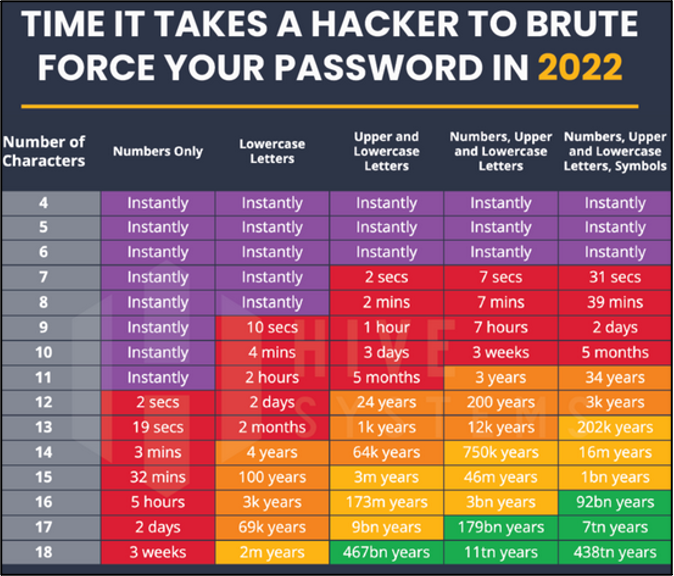
There are many helpful tips for secure passwords, including increasing password length and using a combination of upper and lower-case letters, numbers, and symbols. You may have seen a chart like this showing how difficult it is for a hacker to crack a long and complex password!
Enable Two-Factor Authentication
Two-factor authentication is a method that requires two credentials to be entered to access an account. For example, you may be prompted to enter your password, followed by a code received via text message. The password is the first factor, and the code is the second factor used to authenticate your identity. Some websites are beginning to require two-factor authentication. However, for those that don’t require it you may be able to turn it on yourself in your account settings.
Enjoy today and tomorrow, and let us do the worrying!
Watching your account balances shrink during down markets is never easy. Behavioral economists tell us that the pain people feel watching their investments decline is twice as powerful as the joy of gains. A period of market volatility like we have been experiencing recently is a gut check for even the most experienced investors.
Not too long ago, do-it-yourself investors were reaping the benefits of a rising market.
Notably, 2021 was quite abnormal with the S&P 500 rising approximately 27%. The index returned greater than 20% in only 4 of the 20 years prior.
What’s occurring today is a natural part of markets, but that doesn’t mean that it is comfortable. DIY investors may have simply stopped looking at their investments, which is a perfectly understandable reaction.
Professional managers are always looking and may be first to recognize buying opportunities. DIY investors have a tendency to wait for positive momentum before investing and may miss a significant portion of a recovery.
Some sectors are harder hit than others and professional managers make tactical shifts between them based on their research. We saw that stocks were overvalued last Fall and moved a portion of client assets to private real estate. We have since seen markets break technical support levels and further reduced equities exposure.
We only take meaningful market risk with the assets that can truly stay invested for the long term.
To accomplish this, we keep money that may be needed in shorter timeframes in safer, less volatile investments. We also have direct access to alternative investments that can complement stock risks.
One of the beauties of this paradigm is the reassurance that comes from knowing you’re not going to be forced to sell into down markets.
Speaking with a financial advisor may help alleviate the natural feelings of discomfort that occur during volatile periods.
If you would like to speak with us about your personal financial situation, click here.
So, enjoy today and tomorrow, and let us do the worrying!